How Long Do Tesla Batteries Last? Real Data, Warranty and Health Checks

How long do Tesla batteries last? Most should outlast the eight-year warranty by a wide margin. Tesla’s latest Impact Report, published in July 2026, says Model 3 and Model Y batteries lose only about 20% of their capacity after 200,000 miles, whatever their battery chemistry. Tesla says 200,000 miles takes the average US driver about 15 years.
A study of nearly 300 million UK MOT records found that electric cars now last about 18.4 years on average, with Tesla leading among them (University of Birmingham). That study measures how long the whole car stays on the road, not the battery alone.
You’ll often see “300,000 to 500,000 miles” quoted as a Tesla battery’s lifespan. That figure comes from a 2019 tweet in which Elon Musk said Model 3 battery modules “should last 300k to 500k miles (1500 cycles).”
Elon’s $5,000 to $7,000 module figure was a 2019 US estimate, not a current price. It’s a company claim rather than measured data. How long your own battery lasts depends on its chemistry, the climate and how it’s charged.
I’m a UK owner with a 2019 Tesla Model 3 Long Range on about 36,000 miles and a Tesla Model Y Long Range (Juniper) collected in September 2025. Tesla battery life is one of the biggest worries for buyers, so I’ve pulled together what the mileage records, warranty terms and Tesla’s own battery checks show. That way you can judge a new or used car on evidence, without leaning on rumours.
Key Takeaways
- Lifespan: most Tesla batteries outlast the eight-year warranty. Tesla’s latest data shows Model 3 and Model Y batteries keep about 80% of their capacity after 200,000 miles, whatever their chemistry.
- The “300,000 to 500,000 miles” figure comes from a 2019 Elon Musk tweet, not measured data.
- Warranty: 8 years, with 100,000 to 150,000 miles depending on the model in the UK and US, and at least 70% capacity guaranteed. The end date is when cover stops, not when the battery fails.
- Check your own car: Controls > Service > Battery Health gives Tesla’s verdict on your battery. The optional Battery Health Test needs a charger of at least 5 kW, so a UK 3-pin plug can’t run it.
- Care: follow the daily limit your charging screen recommends, precondition before Supercharging in the cold, and don’t leave the car for weeks near 0% or 100%.
Tesla Battery Lifespan or Range per Charge?
“How long does a Tesla battery last?” can mean two things. If you mean how far one charge takes you, that’s the car’s range.
In the UK, Tesla quotes 332 to 466 miles (WLTP) for the current Model 3 and 309 to 387 miles for the Model Y.
In the US, EPA ratings for the 2027 Model 3 and Model Y run from 294 to 363 miles. The two tests differ, so the same car gets a different figure in each market (Tesla UK and fueleconomy.gov, checked November 2026).
This article is about the other meaning: how many years and miles the battery keeps enough capacity to be useful. As it ages, each full charge gives a little less range than it did when new.
What Does Real-World Data Show About Tesla Battery Life?
Tesla’s own fleet figures and high-mileage cars point to slow capacity loss, but every car has its own history.
What Tesla’s Fleet Data Says About Capacity Retention
Tesla’s 2025 Impact Report, published in July 2026, says Model 3 and Model Y batteries lose about 20% of their capacity after 200,000 miles, regardless of battery chemistry.
Tesla estimates a car reaches the end of its life after about 200,000 miles in the US and about 150,000 miles in Europe, and says 200,000 miles takes the average US driver about 15 years.
Earlier reports gave narrower figures: about 15% loss for Model 3 and Model Y Long Range packs only in the 2023 report, and about 12% for Model S and Model X in the 2022 report. These are averages, so individual cars will sit above and below them.
Individual high-mileage cars tell a similar story. Tesloop, a shuttle company that Supercharged its cars between back-to-back routes, recorded about 13% battery degradation on a Model X after 350,000 miles (CleanTechnica).
Why High-Mileage Teslas Can’t Predict Your Battery’s Lifespan
Famous examples get shared because they’re unusual. One Model S P85 passed 1.5 million km (about 932,000 miles) in January 2022, but its original pack had been replaced under warranty at about 290,000 km (180,000 miles) (InsideEVs). A single car can’t tell you what your car will do.
Climate, charging habits, chemistry and the pack’s build batch all differ from car to car. A few early packs also failed from faults, which is a separate issue from wear.
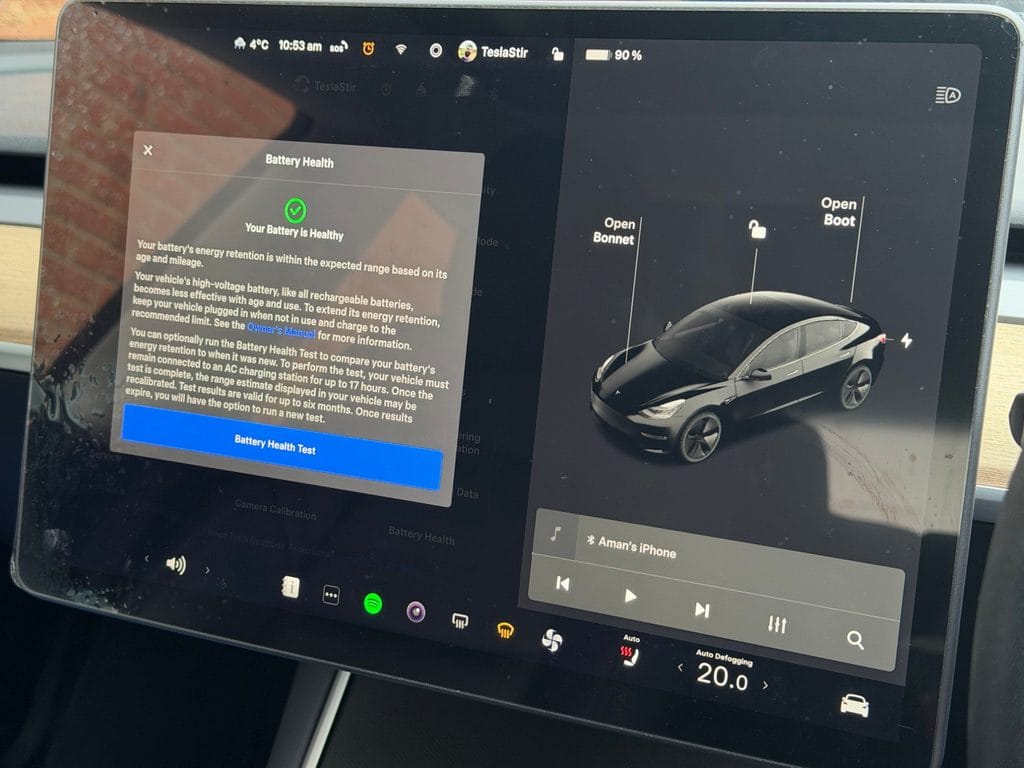
I haven’t measured the degradation on either of my cars, so I won’t give you a percentage of my own. What I can share is Tesla’s own check: in November 2026, the Battery Health screen on both my 2019 Model 3 and my Model Y Long Range (Juniper) said “Your Battery is Healthy” and that its energy retention “is within the expected range based on its age and mileage”.
What Causes Tesla Battery Degradation?
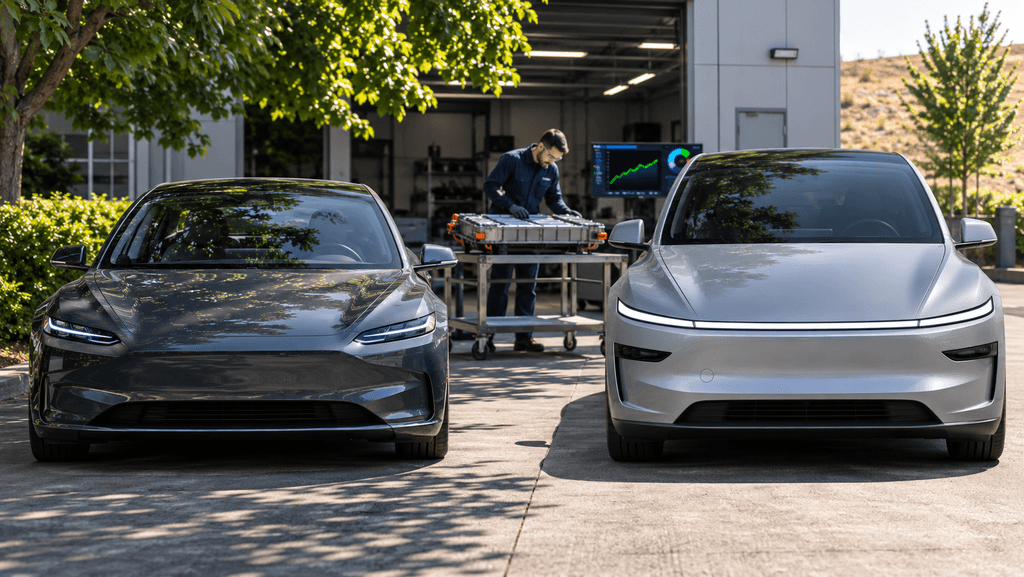
Tesla battery degradation happens in two ways at once: with age and with use. Heat, high states of charge and the type of cell decide how fast each kind of wear happens, while cold weather mostly causes short-term range loss that comes back.
Calendar Ageing vs. Charge Cycles
Calendar ageing happens even when the car sits still. Cells slowly lose capacity over time, and heat plus a high charge level speed this up.
Cycle ageing comes from charging and discharging. Every charge and discharge adds a little wear.
So mileage alone doesn’t decide battery health: a low-mileage car stored at 100% in a hot climate can end up worse than a high-mileage car driven daily. Don’t confuse ageing with the small amount of charge a Tesla loses while parked. That’s energy used to keep the car’s systems running, not permanent wear.
How Lithium Iron Phosphate and Nickel-Based Batteries Differ
Tesla uses two main families of cell:
- Nickel-based (NCA or NMC): found in Long Range and Performance cars, including my Model 3 Long Range. They store more energy for their weight, but they’re happiest kept at a lower daily charge.
- Lithium iron phosphate (LFP): used in many Standard Range and Rear-Wheel Drive Model 3 and Model Y cars. Its charging screen may recommend a different daily limit from a nickel-based car, so follow what your own car shows.
Your car’s chemistry depends on its model, year and factory, so don’t assume charging advice from another owner applies to your car.
Permanent Capacity Loss vs. Temporary Cold-Weather Range Loss
Winter range drops are mostly temporary. A cold pack can’t release or take energy as quickly, and heating the cabin uses extra power. When the weather warms, the range returns.
The real risk is charging hard when cells are very cold. Charging lithium-ion cells below freezing can cause lithium plating, which permanently reduces performance, and Battery University advises a reduced charging current below 5°C (Battery University). In a Tesla, a blue snowflake icon appears when the battery is cold, and Tesla says regenerative braking, acceleration and charging rates may be limited until it warms (Tesla manual). Our guide to the blue snowflake icon explains what it means. Preconditioning before you set off, or navigating to a charger with Trip Planner for 30 to 45 minutes before you arrive, warms the pack first.
What Does the Tesla Battery Warranty Cover?
Tesla’s Battery and Drive Unit Limited Warranty runs for eight years, with a distance limit that depends on the model, and guarantees at least 70% battery capacity over that period. It covers faults and unusually fast capacity loss. Normal wear that leaves at least 70% capacity isn’t a warranty claim.
Tesla Battery Warranty by Model and Market
| Warranty | UK | US and Canada | Rest of Europe |
|---|---|---|---|
| Model 3 and Model Y standard RWD (not Long Range) battery and drive unit | 8 years or 100,000 miles | 8 years or 100,000 miles (160,000 km) | 8 years or 160,000 km |
| Model 3 and Model Y Long Range (Premium Long Range in the UK) and Performance battery and drive unit | 8 years or 120,000 miles | 8 years or 120,000 miles (192,000 km) | 8 years or 192,000 km |
| Model S and Model X battery and drive unit | 8 years or 150,000 miles | 8 years or 150,000 miles (240,000 km) | 8 years or 240,000 km |
| Minimum battery capacity during the warranty | 70% | 70% | 70% |
| Basic Vehicle Limited Warranty | 4 years or 60,000 miles | 4 years or 50,000 miles (80,000 km) | Check your Tesla account |
Whichever limit comes first ends the cover. Sources: Tesla UK, Tesla’s North America warranty (effective 1 September 2026, covering the US and Canada) and Tesla’s Europe warranty (effective 8 July 2024), all checked on 15 November 2026.
The terms have changed over time, and each car keeps the warranty that applied when it was bought. Tesla introduced the 70% minimum capacity guarantee with the Model 3 in 2017, while earlier Model S and Model X battery warranties didn’t cover capacity loss from normal use (Electrek).
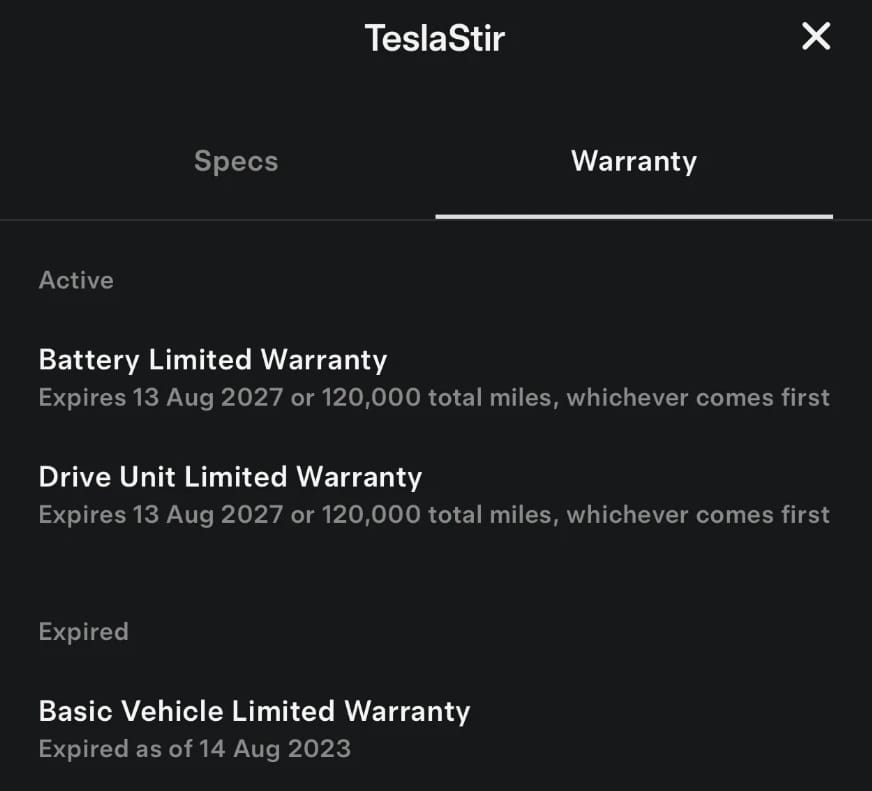
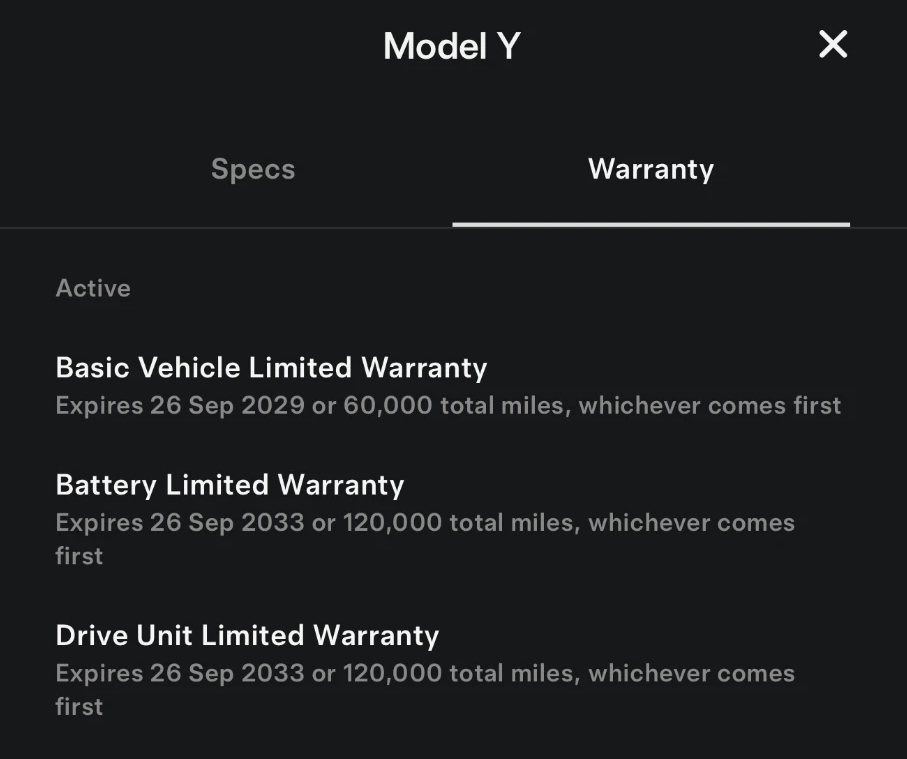
UK note: my own cars show how this works in practice. My 2019 Model 3’s basic warranty ended in August 2023, but its battery and drive unit are covered until August 2027 or 120,000 miles. My Model Y Long Range (Juniper), collected in September 2025, has basic cover until September 2029 or 60,000 miles, and battery and drive unit cover until September 2033 or 120,000 miles.
Any warranty left over transfers to the next owner when the car’s ownership is transferred through Tesla.
Why Warranty Expiry and 70% Capacity Do Not Mean Replacement Is Due
The warranty end date is when Tesla stops paying. It isn’t a forecast of battery failure.
The 70% figure is a floor for a claim. A car with 75% of its original capacity still drives normally; it just covers fewer miles per charge. If you mostly drive locally, that may make little difference day to day.
How to Check Your Car’s Cover and Raise a Battery Concern
To see your cover, open the Tesla app, scroll to the bottom of the home screen and tap Specs & Warranty, then the Warranty tab (Tesla UK). It lists each warranty with its end date and mileage limit, and moves expired ones to a separate list. If range drops suddenly or a battery alert appears, book a visit through the app’s Service menu.
Tesla asks you to include photos, videos, dates, times and environmental conditions when you log a concern. For battery issues, screenshots of full-charge range over several months help a Service Centre see the trend.
How to Check and Protect Tesla Battery Health
Good battery care comes down to following the car’s own charging advice, keeping the pack away from extremes, and warming it before fast charging. Checking health is best done occasionally, with an eye on trends.
Follow Your Car’s Charging Limit Rather Than a Universal Rule
Tesla’s manual tells you to use the recommended daily and trip charging limits shown on the car’s charging screen or in the app. For cars with a recommended daily limit of 80%, it says to keep daily charging at about 80% and save 100% for long drives, and to avoid leaving the battery at or near 0% or 100% for long periods (Tesla manual).
On my Model 3 and Model Y, my usual limit is 80%, and I raise it to 90 to 95% before a long trip such as a run to Scotland. Whatever you drive, follow the daily and trip range your own charging screen shows.
Home Charging vs. Supercharging: What Matters for Battery Wear?
Slow AC charging at home (Level 2 home charging in the US, a Wall Connector or 3-pin plug in the UK) is gentle on cells. Regular DC fast charging adds heat, which speeds wear slightly.
Tesla’s manual suggests charging at home whenever possible and saving Supercharging for road trips, and says the peak charging rate may drop slightly after a large number of DC fast charging sessions. The difference is smaller than many people fear: the Tesloop Model X mentioned earlier was Supercharged between routes and still recorded only about 13% degradation at 350,000 miles.
UK note: my Model Y mostly charges overnight on a 3-pin charger at home, while my Model 3 mostly uses Superchargers. I own a Tesla Wall Connector but haven’t installed it. You can track how you charge with Tesla charge stats.
Use Preconditioning and Avoid Prolonged Storage Near Empty or Full
Before Supercharging in cold weather, precondition your Tesla battery by setting the charger as your navigation destination. The car warms the pack so it charges faster and with less strain.
For storage, avoid leaving the car for weeks at very low or very high charge. Tesla’s manual suggests leaving the battery at around 50% and keeping the car plugged in if possible. In hot weather, Cabin Overheat Protection keeps the cabin cool but uses battery energy while you’re parked, so consider turning it off if the car will sit unplugged for a long time.
What Displayed Range and Available Battery Health Tests Can Tell You
Three checks give you a picture of your battery:
- Battery Health screen: in the car, touch Controls > Service > Battery Health. In the Tesla app, go to Service > Resources > Battery Health. Tesla says it compares data from the battery management system with the expected energy retention for your battery type, age and usage (Tesla manual). It gives a verdict rather than a percentage. On both my cars in November 2026, it said “Your Battery is Healthy”.
- Full-charge range: compare the range shown at a high charge with the original rated figure for your model, year and market (EPA in the US, WLTP in the UK and Europe). Tesla’s warranty notes that range estimates are an imperfect measure of battery capacity, so watch the trend over months rather than one reading.
- Battery Health Test: an optional test that shows a percentage of your battery’s energy retention compared with when it was new, and may recalibrate the range estimate. Tesla recommends it only if you’re concerned about your battery, and not every car has it.
Before You Run the Battery Health Test
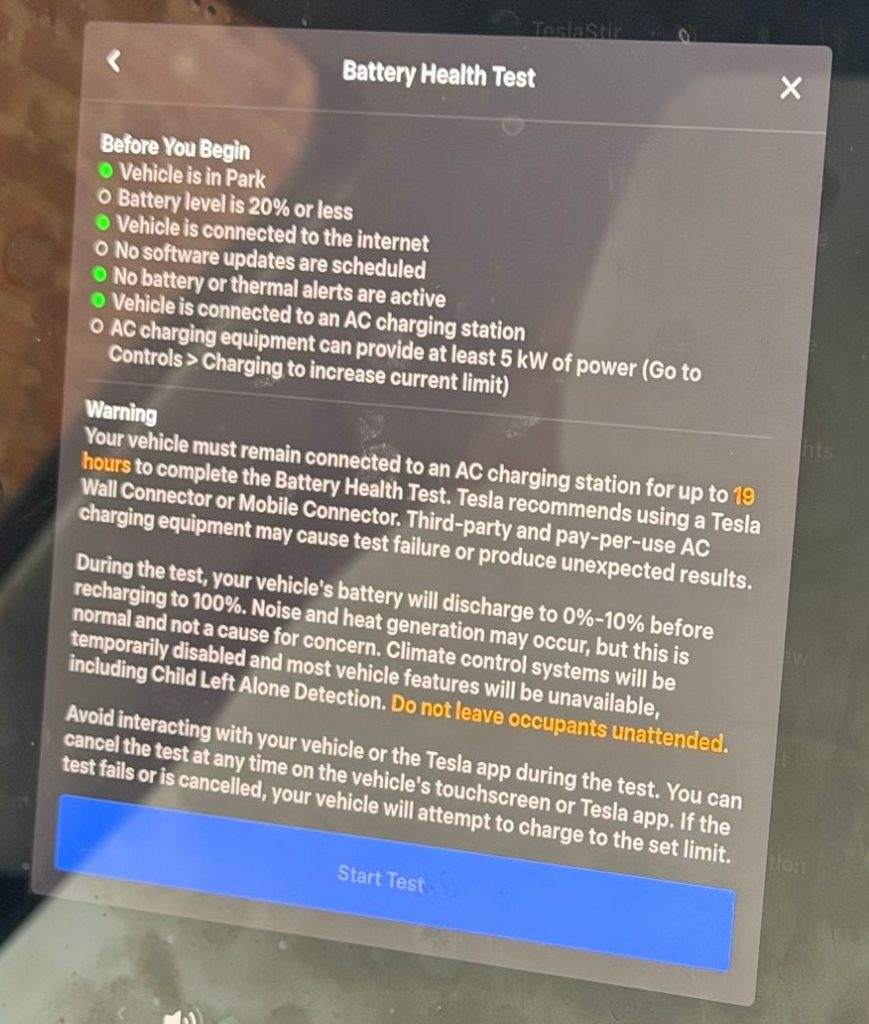
Tesla’s UK and US manuals give the same requirements, and my cars’ screens in the UK showed the same checklist in November 2026:
- The car is in Park, connected to the internet, and has no scheduled software updates.
- The battery is at 20% or less.
- There are no battery or thermal alerts.
- The car is plugged into AC charging that can supply at least 5 kW. Tesla recommends its Wall Connector or Mobile Connector, and warns that third-party and pay-per-use AC chargers may cause the test to fail or give unexpected results.
The manual says the test takes up to 24 hours. My cars’ screens estimated up to 17 hours for the Model 3 and 19 hours for the Model Y. During the test, the battery discharges to between 0% and 10% and then recharges to 100%. Climate control and most features are switched off, so never leave anyone in the car. Results are valid for up to six months.
UK note: a 3-pin socket can’t run the test. Tesla UK rates its Mobile Connector’s UK adapter at 10 A and 2.3 kW, well under 5 kW. When I checked my Model Y on its 3-pin charger, the 5 kW line on the checklist stayed unticked. You’ll need a home charger set to at least 5 kW, or a Mobile Connector on its 32 A blue adapter (rated at 7.4 kW).
US note: a standard 120-volt outlet (Level 1) supplies well under 5 kW too, so you’ll need 240-volt (Level 2) charging rated at 5 kW or more.
When Is Tesla Battery Replacement Necessary?
Replacement is needed when a pack has a fault or has worn so far that the car no longer suits your driving. Prices vary widely by model, market and whether you choose a new, refurbished or repaired pack.
Gradual Degradation vs. Faults That Need Diagnosis
Slow, steady loss over the years is normal. A sudden or fast drop is what needs checking.
Warning signs that need a proper diagnosis include:
- A sudden drop in range over days or weeks
- Battery or high-voltage alerts on the screen
- The car refusing to charge to its set limit with a working charger
- Charging that stops repeatedly at more than one charger
If a Supercharger session fails, I try another bay first. Since 2019 my occasional failed sessions have been fixed that way, so one bad stall is no reason to suspect the battery.
What a Replacement Quote Should Include
Ask for a written quote that lists the parts, labour, diagnostics and VAT (or sales tax in the US), and how long the replacement is warranted. Tesla’s warranty doesn’t cover damage caused by the battery being serviced or opened by non-Tesla or non-certified technicians.
What to Check Before Buying a Used Tesla
Before you buy, ask the seller to show the car at a full or near-full charge, and compare the range with the original figure for that model and year. Ask for the charging history if possible, and check how much battery warranty remains for your market.
Look at the Software screen for the model variant and build details, confirm the battery chemistry, and check the Battery Health screen (Controls > Service > Battery Health). A car with a slightly lower range but years of warranty left can be a better buy than one that looks perfect with none.
Plan Around Battery Condition, Not a Replacement Deadline
A Tesla battery wears gradually, and for most owners it will keep working long past the eight-year warranty. The useful question is how much range you have today and whether it still fits your driving.
Check the Battery Health screen and your full-charge range once or twice a year, keep daily charging within the car’s recommended limit, and precondition before fast charging in the cold. Our Tesla range tips cover daily habits that get more miles from each charge.
If range falls quickly or a battery alert appears, log it in the app with screenshots and dates while you’re still under warranty. If you’re buying used, weigh remaining warranty and current range ahead of the car’s age alone.
Buying your first Tesla? If you order a new Model 3 or Model Y through my referral link, Tesla currently gives UK buyers 650 free Supercharging miles, and I get referral credits too. The link has to be used before you place your order, and Tesla’s benefits change, so check what it shows for your country. (Disclosure: this is my referral link.)
Frequently Asked Questions
Can a Tesla battery last more than 10 years?
Yes, for most cars. Tesla’s latest Impact Report says Model 3 and Model Y batteries still have about 80% of their capacity after 200,000 miles, which it says takes the average US driver about 15 years. A UK study of MOT records found electric cars now last about 18.4 years, with Tesla leading among them. Heat, age and charging habits affect each car.
Can a Tesla reach 300,000 miles on its original battery?
Yes. Tesloop’s Model X shuttle passed 350,000 miles with about 13% battery degradation. Others have needed a replacement earlier, so one car’s record isn’t a guarantee.
Do Model 3 and Model Y batteries have different lifespans?
No difference has been shown. Tesla reports one combined figure for both: about 20% capacity loss after 200,000 miles, whatever the battery chemistry. Climate and charging habits matter more than body style, and their battery warranties match in each market.
How common is Tesla battery failure?
Most packs lose capacity slowly rather than failing outright, as Tesla’s fleet figures above show. A fault within the warranty’s time and mileage limits is covered by the battery warranty, so log any sudden change in the app.
Does cold weather permanently damage a Tesla battery?
Cold weather mostly causes temporary range loss that returns when temperatures rise. The car limits charging rates and regenerative braking while the battery is cold, and preconditioning warms the battery before charging.
How many miles can a Tesla travel between charges?
It depends on the model, version and market. In the UK, Tesla quotes 332 to 466 miles (WLTP) for the current Model 3 and 309 to 387 miles for the Model Y. In the US, EPA ratings for 2027 Model 3 and Model Y versions run from 294 to 363 miles. Real-world range drops in winter, at motorway speeds and with heavy loads, and it falls slightly as the battery ages.
How much does a Tesla battery replacement cost?
Out of warranty, a full pack costs five figures. UK owners reported a Tesla estimate of £13,834.88 and a bill of £13,100 for a pack and related parts in autumn 2026, and one widely shared US Model 3 invoice came to about $15,800. Our guide to Tesla battery replacement cost has the details and real UK owner cases.